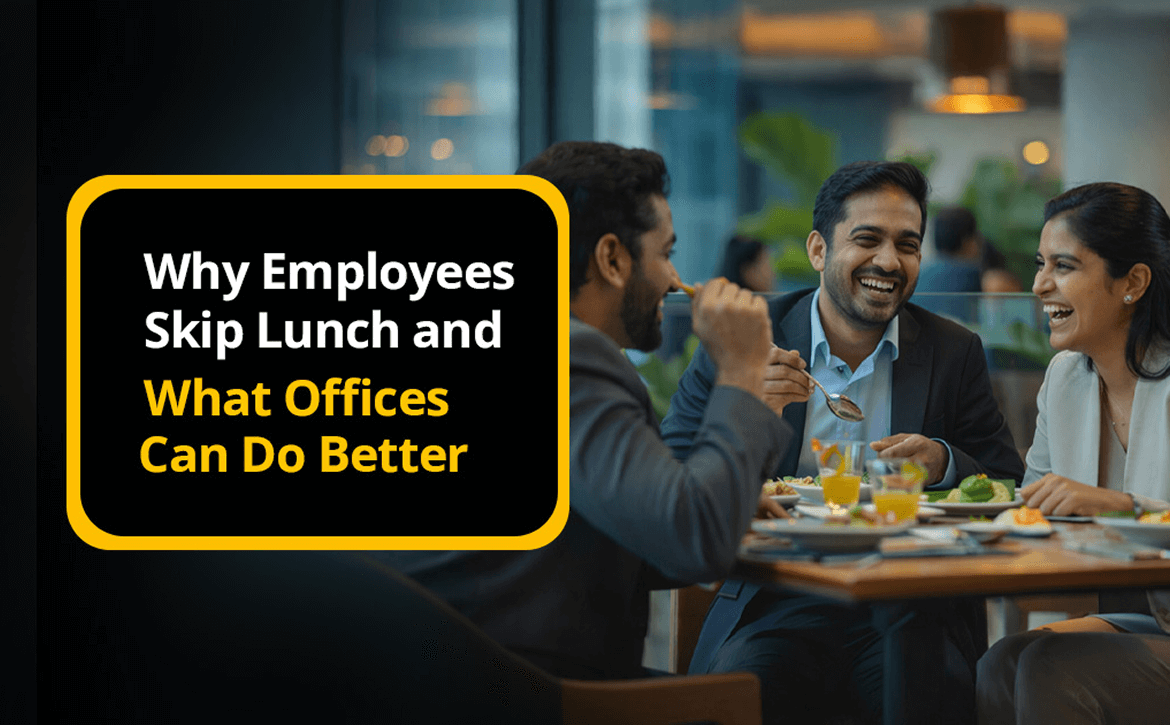
Why Employees Skip Lunch and What Offices Can Do Better
Employees skipping lunch has consequences far more serious than most organizations realize.
As founders and leaders, it is easy to believe there are bigger priorities competing for attention. Revenue targets, client commitments, hiring plans, product timelines. Lunch feels optional in comparison. But pause for a moment and think about this. Can you truly expect consistent performance, creativity, and focus from people whose basic needs are being ignored?
Health is not a “nice to have.” It is the foundation of everything people think, build, and deliver. And when employees regularly skip meals, even unintentionally, the impact quietly shows up in ways that are easy to miss but costly over time.
This is where corporate meals stop being a cultural perk and start becoming a strategic decision.
Providing meals at the workplace is not about optics or employer branding alone. It is about creating an environment where employees can function at their best without unnecessary friction. When nourishment is taken care of, energy stabilizes, focus improves, and productivity becomes more sustainable.
When health thrives, performance follows naturally.
Let’s first understand why employees skip meals in the first place.
Real Reasons Why Employees Skip Lunch
Employees rarely skip meals because they want to. It usually happens because the work environment makes it easier to skip lunch than to take one.
1. Work Pressure and Constant Deadlines
Heavy workloads and back-to-back meetings often push lunch to the bottom of the priority list. Employees tell themselves they will eat later, but later never comes. Over time, skipping lunch becomes routine rather than an exception.
The result is predictable. Energy drops mid-afternoon, focus becomes harder to sustain, and small tasks start taking longer than they should. It is not a motivation problem. It is a fuel problem.
2. Poor Access to Nutritious Food
If the only nearby options are unhealthy, expensive, or time-consuming, employees choose convenience over nourishment. Many simply grab coffee, snack mindlessly, or skip eating altogether to save time.
Even when employees want to eat better, the friction is high. Long queues, limited variety, inconsistent quality, and the effort of deciding every day make healthy eating feel like extra work. Convenience wins, and nutrition loses.
3. Lack of Structured Breaks
In many offices, breaks exist on paper but not in practice. When teams do not see leaders stepping away for meals, they subconsciously feel guilty doing so themselves.
Lunch becomes a “nice-to-have” that gets sacrificed whenever something feels urgent. People eat at their desks, rush through meals, or postpone eating until they are already drained. This creates a cycle where teams normalize unhealthy patterns because “everyone is doing it.”
4. Remote and Hybrid Work Patterns
For hybrid teams, the boundaries between work and personal time blur. Employees jump from one call to another, often forgetting to pause and eat properly.
At home, there is no shared lunch rhythm. People eat inconsistently, snack too often, or skip meals entirely. Over time, this affects not just energy levels, but mood, engagement, and the ability to show up mentally sharp for meetings.
5. A Culture That Rewards Overworking
When long hours are celebrated, and breaks are seen as a weakness, employees internalize the message that meals are optional and productivity means pushing through hunger.
6. Decision Fatigue and Meal Planning Friction
Even when food is available, deciding what to eat every day becomes another task on the list. Employees either waste time choosing, settle for whatever is easiest, or delay eating because they cannot decide.
When work is intense, people do not want more decisions. They want a reliable default that removes friction and keeps them going.
7. Inconsistent Office Food Options
Many teams rely on scattered solutions like ad-hoc ordering, random vendors, or occasional snacks. Some days there is food, other days there is nothing.
This inconsistency makes meals feel unreliable, so employees stop depending on them. When lunch is uncertain, skipping becomes the safer option.
Why Skipping Lunch Matters More Than You Think
Skipping meals does not just affect individual health. It directly impacts business outcomes.
Hunger leads to lower concentration, slower decision-making, and reduced problem-solving ability. Energy crashes in the afternoon cause disengagement, irritability, and errors. Over time, this contributes to burnout, absenteeism, and high turnover.
From a leadership standpoint, this is a silent leak. Productivity loss does not show up as a single failure. It accumulates slowly across teams and months.
Well-fed employees are more alert, collaborative, and resilient. They show up with energy rather than exhaustion. And when employees feel cared for, loyalty and morale improve naturally.
Food is not just fuel. It is a signal. It tells employees whether their well-being genuinely matters to the organization.
What Top Management Can Do About it
Leadership sets the tone. If founders and managers treat meals as essential, employees will too.
- Make Meals Accessible, Not Optional
Providing on-premise or scheduled corporate meals removes friction. Employees no longer have to choose between eating and meeting deadlines.
- Normalize Lunch Breaks
When leadership takes visible breaks and respects meal times, employees feel permission to do the same without guilt.
- Prioritize Nutrition, Not Just Convenience
Balanced meals lead to sustained energy, not short-term sugar spikes. Thoughtful meal planning reflects long-term thinking.
- Use Meals to Build Connection
Shared meals encourage informal conversations, collaboration, and stronger team bonds. This social aspect matters more than most companies realize.
- Partner with a Reliable Corporate Meal Provider
Consistency is key. Employees should not have to wonder whether meals will be available or worth their time.
This is where companies like BitesBess step in as a practical solution rather than a perk.
BitesBee Corporate Meals To Power High-Performing Teams
BitesBee understands that corporate meals are not about filling plates. They are about supporting people.
By offering reliable, nutritious, and thoughtfully curated meals, BitesBess helps organizations remove one of the most common productivity barriers. Employees no longer skip lunch because food is accessible, timely, and designed for real workdays.
For leadership, this means fewer energy slumps, better engagement, and a workplace that genuinely supports performance rather than draining it. It is a simple shift with a compounding impact.
Ready to make lunch a performance advantage at your office?
Start with BitesBee and build a corporate meal program your team can rely on every single day.
Conclusion
Employees skipping lunch is not a small issue. It is a signal that something in the system needs attention.
Organizations that take employee well-being seriously understand that productivity is built on health, not pressure alone. Corporate meals are one of the most effective and overlooked ways to support that foundation.
When you feed your people well, you give them the energy to think clearly, collaborate better, and deliver consistently.
And when employees feel supported at a fundamental level, they do not just work harder. They work better.
With partners like BitesBess, offices can move beyond assumptions and start building workplaces where performance and well-being grow together.